
Geometry Unit 3 Test Answer Key PDF: A Comprehensive Plan
A detailed PDF answer key unlocks deeper understanding, offering step-by-step solutions and alternative methods for tackling challenging geometry problems within Unit 3 assessments.
Geometry Unit 3 tests typically assess a student’s grasp of fundamental concepts relating to lines, angles, and foundational elements of circles. These assessments frequently include problems requiring calculations of slopes, identification of angle relationships formed by transversals, and classifications of triangles based on their sides and angles. A robust geometry unit 3 test answer key PDF is therefore crucial for effective learning and self-evaluation.
These tests aren’t merely about memorizing formulas; they evaluate a student’s ability to apply geometric principles to solve practical problems. The presence of a detailed answer key, beyond simply providing correct answers, allows students to dissect the logic behind each solution. This dissection fosters a deeper comprehension of the underlying mathematical reasoning, preparing them for more complex geometric challenges in subsequent units and beyond.
The Importance of Answer Keys
A geometry unit 3 test answer key PDF transcends simple correctness checking; it’s a powerful pedagogical tool. Beyond verifying solutions, a comprehensive key reveals the ‘how’ and ‘why’ behind each answer, exposing students to diverse problem-solving approaches. This is particularly valuable when encountering challenging concepts like angle relationships or slope calculations.
The key facilitates self-directed learning, allowing students to pinpoint areas of weakness and focus their study efforts effectively. Detailed step-by-step solutions demonstrate alternative techniques, potentially unveiling more efficient or intuitive methods. Furthermore, identifying common errors within the key’s explanations proactively prevents students from repeating those mistakes on future assessments, ultimately boosting their confidence and overall geometric understanding.
Understanding Common Geometry Unit 3 Topics
A geometry unit 3 test answer key PDF often centers around core concepts like triangle classification – by sides (isosceles, scalene, equilateral) and angles (acute, obtuse, right). Mastery of angle relationships is crucial, including corresponding, alternate interior/exterior, and consecutive interior/exterior angles formed by transversals. Linear equations, specifically slope-intercept form, and calculating slope given two points, are frequently assessed.
Circle geometry fundamentals, encompassing radius, diameter, chords, secant and tangent lines, arcs (major, minor, semi-circles), and angles (central, inscribed, right angles within circles), also dominate Unit 3. An effective answer key will not only provide correct answers but also demonstrate how these concepts interrelate when solving complex problems, offering a holistic understanding.
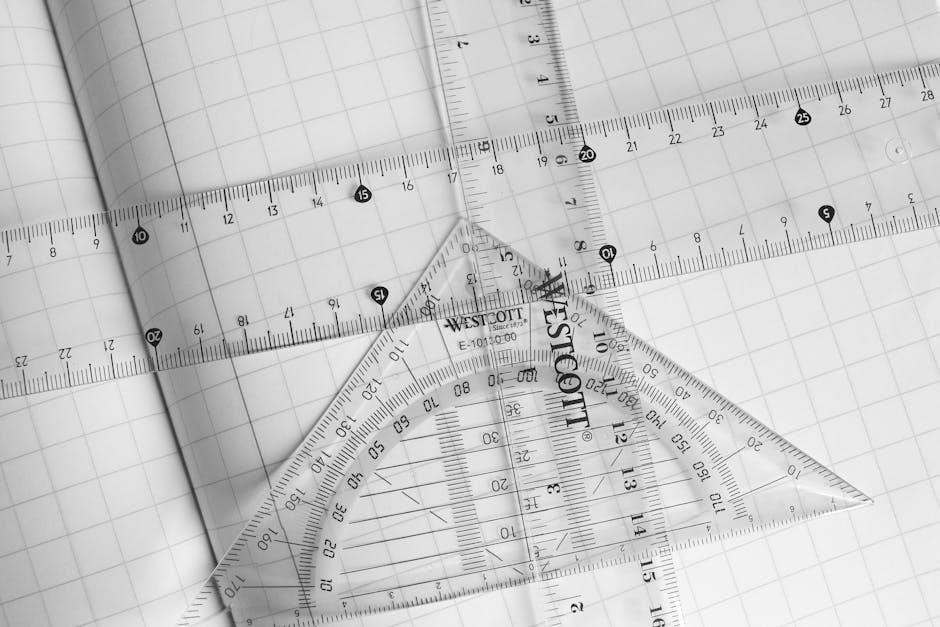
Core Concepts Covered in Unit 3
Unit 3’s core focuses on triangles, angle relationships, linear equations, and circle geometry, all thoroughly tested and clarified within a comprehensive answer key PDF.
Triangles: Classification by Sides
Understanding triangle classification by sides – equilateral, isosceles, and scalene – is fundamental in Geometry Unit 3. An effective answer key PDF will not only confirm correct identification but also demonstrate why a triangle fits a specific category. For instance, it will showcase how to verify all three sides are equal for an equilateral triangle, or how two sides being equal defines an isosceles triangle.
The key should include diagrams with labeled sides, reinforcing visual learning. It’s crucial to see examples where students might misclassify, like assuming a triangle is isosceles based on appearance alone. A robust answer key will detail the process of accurately measuring or calculating side lengths to arrive at the correct classification. Furthermore, it should address problems involving algebraic expressions representing side lengths, requiring students to solve for variables before classifying.
Triangles: Classification by Angles
A comprehensive Geometry Unit 3 answer key PDF must thoroughly cover triangle classification by angles: acute, right, and obtuse. It shouldn’t simply state the answer, but explain how to determine the angle type. For example, demonstrating how to confirm all angles are less than 90 degrees for an acute triangle, or identifying a 90-degree angle for a right triangle.
The key should feature diagrams with clearly marked angles, aiding visual comprehension. It’s vital to address common errors, such as misinterpreting visual estimations of angles. Detailed solutions should include calculations when angles are represented by algebraic expressions, requiring students to solve for ‘x’ before classifying. The PDF should also showcase how the sum of angles in a triangle (180 degrees) is used to verify classifications and solve for missing angles.
Angle Relationships: Corresponding Angles
A robust Geometry Unit 3 answer key PDF dedicated to corresponding angles must clearly illustrate their position when formed by a transversal intersecting two lines. It should visually demonstrate how corresponding angles occupy the same relative position at each intersection. The key needs examples showing how to identify corresponding angles – for instance, angles 1 and 5, 2 and 6, etc. – and explicitly state their congruence (equal measure).
Solutions should include problems where students must apply the corresponding angles postulate to solve for unknown angle measures. The PDF should address potential confusion with other angle pairs. Diagrams should be well-labeled, and step-by-step explanations should highlight the logic behind determining corresponding angle relationships.
Angle Relationships: Alternate Interior Angles
A comprehensive Geometry Unit 3 answer key PDF concerning alternate interior angles must provide clear visual examples of their formation. It should demonstrate how these angles lie on opposite sides of the transversal and inside the two intersected lines. The key needs to explicitly state the postulate: alternate interior angles are congruent. Detailed solutions should showcase problems requiring students to identify these angles – for example, angles 3 and 6, or 4 and 5 – and utilize their congruence to calculate unknown measures.
The PDF should also address common student errors, like confusing them with alternate exterior angles. Step-by-step explanations, coupled with well-labeled diagrams, are crucial for understanding the underlying principles.
Angle Relationships: Alternate Exterior Angles
A robust Geometry Unit 3 answer key PDF dedicated to alternate exterior angles must visually illustrate their positioning. These angles reside on opposite sides of the transversal, but outside the two intersected lines. The key should firmly establish the postulate: alternate exterior angles are congruent. Problem solutions should demonstrate identifying these angles – such as angles 1 and 8, or 2 and 7 – and applying their congruence to determine missing angle measurements.
The PDF should proactively address potential student confusion with alternate interior angles, providing clear distinctions. Detailed, labeled diagrams and step-by-step explanations are vital for solidifying comprehension. Furthermore, the key should include examples where students must apply the concept to solve for ‘x’ or other variables within geometric figures.
Angle Relationships: Consecutive Interior Angles
A comprehensive Geometry Unit 3 answer key PDF concerning consecutive interior angles must clearly define their location and relationship. These angles lie on the same side of the transversal and inside the two intersected lines. Crucially, the key should emphasize the postulate: consecutive interior angles are supplementary – meaning they add up to 180 degrees.

Solutions should showcase identifying these angle pairs (e;g., angles 3 and 6, or 4 and 5) and setting up equations to solve for unknown angles. The PDF should differentiate these from alternate interior angles, a common student error. Detailed diagrams with clear labeling are essential. The answer key should also include problems requiring students to apply this knowledge within more complex geometric scenarios, demonstrating a practical understanding of the concept.
Angle Relationships: Consecutive Exterior Angles
A robust Geometry Unit 3 answer key PDF addressing consecutive exterior angles needs precise explanations and illustrative examples. These angles are positioned on the same side of the transversal, but outside the two intersected lines. The key must highlight the fundamental principle: consecutive exterior angles are also supplementary, totaling 180 degrees.
Solutions should demonstrate identifying these angle pairs (like angles 1 and 8, or 2 and 7) and constructing equations to determine unknown angle measures. The PDF should explicitly contrast these with alternate exterior angles to prevent confusion. Clear diagrams with accurate labeling are paramount. Furthermore, the answer key should include problems where students apply this concept to solve for angles in more intricate geometric figures, proving a thorough grasp of the relationship.

Solving Problems & Equations
The answer key PDF must demonstrate equation solving techniques, particularly those involving slope and linear equations, crucial for Unit 3 geometry applications.
Slope-Intercept Form of a Line
The geometry unit 3 test answer key PDF should thoroughly illustrate the slope-intercept form (y = mx + b) and its application to linear equations encountered in geometric contexts. Detailed solutions must showcase how to identify the slope (m) and y-intercept (b) from equations, and conversely, how to construct an equation given these parameters.

Specifically, the key should demonstrate solving for ‘y’ to achieve slope-intercept form, even when the equation is initially presented in standard form. Examples should include problems where students are given a point and the slope, requiring them to calculate ‘b’. Furthermore, the PDF should feature problems mirroring question 21 from the provided text – finding the equation of a line perpendicular to a given line and passing through a specific point. This necessitates understanding negative reciprocal slopes. Clear, step-by-step explanations are paramount for student comprehension.
Finding the Slope Given Two Points
A robust geometry unit 3 test answer key PDF must comprehensively cover calculating slope when provided with two coordinate points. It should explicitly demonstrate the slope formula: m = (y₂ ౼ y₁) / (x₂ ౼ x₁), with clear labeling of coordinates. The key should include numerous examples, varying the quadrant locations of the points to reinforce understanding regardless of sign conventions.
The PDF should address potential pitfalls, such as correctly substituting coordinates and simplifying fractions. Question 22 from the provided text – finding ‘k’ given two points and a slope – exemplifies the type of problem the answer key must solve in detail. It should also showcase how to handle cases where the denominator is zero, leading to an undefined slope (vertical line). Step-by-step solutions, emphasizing the order of operations, are crucial for students to master this fundamental skill.
Graphing Linear Equations
A complete geometry unit 3 test answer key PDF necessitates detailed guidance on graphing linear equations, building upon the slope-intercept form (y = mx + b). It should demonstrate how to accurately plot the y-intercept (b) and then use the slope (m) – rise over run – to identify additional points. The key must include examples of equations in slope-intercept form, like y = 3 (question 23a), and explain how to represent horizontal and vertical lines (x = 5).
The PDF should illustrate how to create a precise graph, emphasizing the importance of using a ruler and labeling axes correctly. It should also address scenarios where equations need to be rearranged into slope-intercept form before graphing. Clear, step-by-step visual representations alongside written explanations are vital for student comprehension. The answer key should also cover interpreting graphs to determine slope and y-intercept;

Circle Geometry Fundamentals
The answer key PDF must define key terms—radius, diameter, chord, secant, tangent—and illustrate major/minor arcs, central/inscribed angles, and right angles.
Defining Circle Terminology: Radius, Diameter, Chord
A robust answer key PDF for Unit 3 geometry meticulously defines fundamental circle components; The radius, the distance from the center to any point on the circle, is clearly illustrated. The diameter, traversing the circle through the center, is defined as twice the radius, with diagrams showcasing its relationship. Crucially, the key explains a chord – a line segment connecting two points on the circle – differentiating it from the diameter.
Visual representations within the PDF are essential, labeling each component accurately. Explanatory notes should accompany each definition, clarifying how these elements interact. The answer key should also include practice problems where students identify these components in various circle diagrams, reinforcing their understanding. Furthermore, it should address common misconceptions, such as confusing a chord with a diameter or incorrectly identifying the radius.
Secant Lines and Tangent Lines
A comprehensive Unit 3 geometry answer key PDF thoroughly clarifies secant and tangent lines within circle contexts. Secant lines, intersecting the circle at two distinct points, are visually defined with clear diagrams illustrating their properties. The key details how to calculate segment lengths formed by intersecting secants. Tangent lines, touching the circle at only one point (the point of tangency), are explained, emphasizing the 90-degree angle formed with the radius at that point.
The PDF should include worked examples demonstrating how to find missing angles and lengths involving secants and tangents. It must address theorems related to tangent segments from an external point being congruent. Practice problems should challenge students to differentiate between secant and tangent lines and apply relevant formulas. Addressing common errors, like misinterpreting the point of tangency, is crucial for effective learning.
Arcs: Major, Minor, and Semi-Circles
A robust geometry Unit 3 answer key PDF provides clear definitions and visual representations of different arc types. Minor arcs, the shorter arc connecting two points on a circle, are distinguished from major arcs, the longer arc between the same two points. The key should illustrate how to measure arcs in degrees, corresponding to their central angle. Semi-circles, precisely half of a circle, are also clearly defined and differentiated.
The PDF must include examples calculating arc lengths using the formula: arc length = (central angle/360) * 2πr. Practice problems should require students to identify arc types, calculate their measures, and relate them to central and inscribed angles. Addressing potential confusion between arc measure and arc length is vital. Diagrams should clearly label minor, major, and semi-circular arcs for easy comprehension.
Central Angles and Inscribed Angles
A comprehensive Unit 3 geometry answer key PDF must thoroughly explain the relationship between central and inscribed angles. Central angles, originating from the circle’s center, directly correspond to the arc they intercept, with equal measures. Conversely, an inscribed angle is half the measure of its intercepted arc.
The PDF should feature diagrams illustrating this key relationship, alongside practice problems requiring students to calculate angle measures given arc lengths or vice versa. It needs to demonstrate how to find missing angles within circles, utilizing theorems related to inscribed angles intercepting the same arc or a diameter. Step-by-step solutions should clarify the logic behind each calculation, preventing common errors. The key should also address scenarios involving combined angles and complex diagrams.
Right Angles within Circle Geometry
A robust geometry Unit 3 test answer key PDF must detail the crucial connection between inscribed angles and right angles within circles. Specifically, an inscribed angle intercepting a semicircle—a 180-degree arc—always measures 90 degrees, forming a right angle. The PDF should showcase numerous examples demonstrating this theorem, including diagrams where students must identify right triangles formed within circles.
Solutions should clearly articulate why this relationship holds true, reinforcing the underlying geometric principles. Practice problems should involve calculating side lengths of right triangles inscribed in circles, utilizing the Pythagorean theorem alongside circle properties. The key should also address scenarios where students need to determine if an angle is a right angle based on its intercepted arc. Detailed explanations prevent confusion and solidify understanding.

Analyzing Test Questions & Solutions
The answer key PDF facilitates detailed solution analysis, revealing step-by-step processes and alternative approaches to problem-solving within the geometry unit 3 test.
Step-by-Step Solution Analysis
A robust geometry unit 3 test answer key PDF doesn’t merely present the final answer; it meticulously breaks down each problem’s solution into manageable, sequential steps. This granular approach is invaluable for students seeking to comprehend the underlying logic and mathematical reasoning. Examining these detailed solutions exposes learners to various techniques, potentially unveiling more efficient or intuitive methods they hadn’t previously considered.
For instance, when solving for ‘x’ and missing angles, the key illustrates each algebraic manipulation. When classifying triangles, it clarifies the reasoning behind side or angle-based categorization. Furthermore, analyzing solutions for slope calculations or graphing linear equations demonstrates the correct application of formulas and graphical interpretations. This step-by-step format empowers students to independently tackle similar problems, fostering a deeper understanding of geometric principles and enhancing their problem-solving skills.
Identifying Alternative Solution Methods
A comprehensive geometry unit 3 test answer key PDF frequently showcases multiple pathways to arrive at the correct solution, expanding a student’s mathematical toolkit. Recognizing these alternatives is crucial, as it demonstrates that problem-solving isn’t always linear. For example, a problem involving angle relationships might be solved using properties of parallel lines cut by a transversal, or through applying the principles of triangle angle sums.
Similarly, calculating slope can be achieved directly from two points or by interpreting the equation of a line. The key highlights these diverse approaches, encouraging students to think critically and select the most efficient method based on the problem’s specifics. This flexibility builds confidence and adaptability, essential skills for success in advanced mathematical studies and real-world applications.
Common Mistakes and How to Avoid Them
A robust geometry unit 3 test answer key PDF doesn’t just present correct answers; it proactively identifies frequent student errors and explains how to circumvent them. Common pitfalls include misapplying angle relationship theorems (confusing corresponding with alternate interior angles, for instance) or incorrectly calculating slope due to sign errors.
The key often flags these tendencies, providing clear explanations and reminders of the correct procedures. It might also emphasize the importance of carefully labeling diagrams or double-checking calculations. By anticipating these mistakes, students can develop preventative strategies, fostering accuracy and reducing careless errors. This proactive approach transforms the answer key from a simple verification tool into a powerful learning resource.

Utilizing the Answer Key for Effective Study
The PDF answer key empowers self-assessment, pinpointing knowledge gaps and guiding focused practice for improved comprehension of Unit 3 geometry concepts.

Self-Assessment and Identifying Weaknesses
Employing the geometry unit 3 test answer key as a self-assessment tool is paramount for student success. Initially, attempt the test independently, simulating exam conditions to gauge true understanding. Subsequently, meticulously compare your solutions with the provided key, not merely checking for correctness, but analyzing how discrepancies arose.
Did errors stem from conceptual misunderstandings, careless calculation mistakes, or misinterpreting the question? Categorizing these error types is crucial. A pattern of mistakes in triangle classifications suggests revisiting those core concepts. Difficulty with angle relationships indicates a need for further practice identifying corresponding, alternate, or consecutive angles.
The answer key isn’t just about finding the right answer; it’s a diagnostic instrument. Identifying specific weaknesses allows students to concentrate their study efforts, maximizing efficiency and fostering a deeper, more robust grasp of Unit 3 geometry principles. Targeted practice, focusing on areas of deficiency, will yield significant improvements.
Practice Problems and Reinforcement
Beyond simply checking answers, the geometry unit 3 test answer key facilitates targeted practice and concept reinforcement. Utilize the key to identify problem types that presented challenges during self-assessment. Seek out additional practice problems mirroring those difficulties – textbooks, online resources, or worksheets are valuable tools.
Don’t just repeat the same problems; explore variations. If struggling with slope-intercept form, practice creating equations from different points or finding slopes from varied coordinate pairs. For circle geometry, focus on identifying radii, diameters, and tangents in diverse diagrams.
Work through these practice problems without immediately consulting the answer key. This fosters independent problem-solving skills. Only refer to the key after a genuine attempt, analyzing the solution process to solidify understanding. Consistent, focused practice, guided by the answer key’s insights, is key to mastery.
Preparing for Retests and Future Assessments
The geometry unit 3 test answer key isn’t just for the initial test; it’s a powerful tool for retesting and future success. If a retest is offered, meticulously review incorrect answers, focusing on the underlying concepts. Don’t simply memorize solutions – understand why your initial approach was flawed.
Create a dedicated study plan addressing identified weaknesses. Prioritize topics causing consistent difficulty. Utilize the answer key to work through similar problems repeatedly, building confidence and fluency.
Looking ahead, recognize that Unit 3 concepts form a foundation for more advanced geometry topics. A strong grasp of triangles, angles, and linear equations will be invaluable. Regularly revisit the answer key as a refresher, ensuring long-term retention and preparedness for subsequent assessments.
Real-World Applications of Unit 3 Geometry
Beyond the classroom, the principles mastered with the geometry unit 3 test answer key are surprisingly prevalent in everyday life. Understanding slope-intercept form, for instance, is crucial in fields like architecture and engineering, calculating roof pitches or bridge inclines.
Angle relationships are fundamental to navigation, surveying, and even art and design. Analyzing intersecting lines helps determine optimal traffic flow or the structural integrity of buildings. Circle geometry concepts appear in wheel design, clock mechanisms, and satellite dish construction.
Effectively utilizing the answer key fosters a deeper comprehension, enabling students to recognize and apply these geometric principles to solve practical, real-world problems, bridging the gap between theory and application.